

After nearly a year in orbit, the US Space Force’s secretive X-37B is prepped to perform some fancy new maneuvers to alter its orbit and dump its service module before carrying on with more mysterious work.
Usually tight-lipped about the X-37B’s orbital operations, the Space Force said yesterday that the seventh orbital test vehicle mission (OTV-7) would be the first time relying on aerobraking to slow a path around the Earth and reduce orbit.

An artist’s rendering of the X-37B conducting its aerobrake maneuver, sans service module – Click to enlarge
Aerobraking has been used in previous space missions, including the ESA’s ExoMars orbiter, the Venus Express, and others. The technique involves an elliptical orbit around a planet, using atmospheric drag and a tight periapsis to gradually reduce the orbit’s maximum distance. Since it relies on the atmosphere to slow the craft, it requires much less fuel, making it ideal for extended missions.
“This first of a kind maneuver from the X-37B is an incredibly important milestone for the United States Space Force as we seek to expand our aptitude and ability to perform in this challenging domain,” said USSF chief of space operations, General Chance Saltzman.
We’ve got some junk to ditch
The US Space Force has shared very few details about the X-37B’s activities in orbit, but when it goes up, it stays up for the long haul.
Its six previous missions have all gradually become longer: Its first in 2010 was less than a year, but since then, it’s managed to achieve a 908-day flight after landing in late 2022 at the end of OTV-6. That nearly two-and-a-half-year mission was also the first to send the X-37B into orbit with a service module in the form of a ring-like attachment at the rear of the craft.
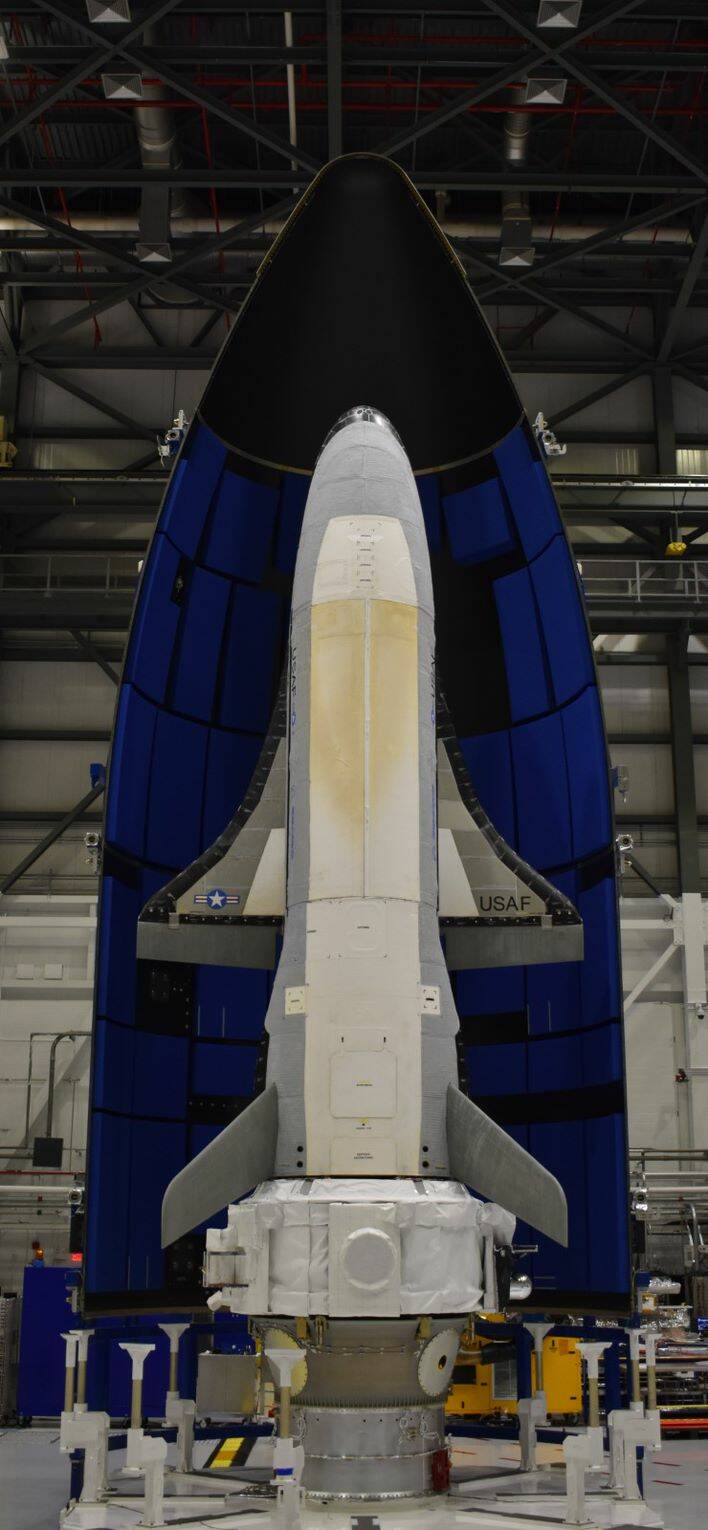
The X-37B before OTV-6 with the service module attached (the white ring at the back) – Click to enlarge
It’s not immediately clear if the service module on OTV-7 is of the same design, or if it’s bigger. As we noted in our discussion of OTV-7’s choice of a SpaceX Falcon Heavy for launch, the rocket gave the Space Force way more cargo capacity, meaning the service module could be larger.
Either way, it looks like the plan is to get it ejected from the craft itself as part of the aerobraking maneuver. According to the Space Force, part of the orbital adjustment will include the X-37B “safely dispos[ing] of its service module components in accordance with recognized standards for space debris mitigation.”
This i